February 28, 2015

Waiting on delivery from OZ

Waiting for rudder sleeves from OZ.
Well, not just the sleeves, but also the fancy kick up mechanism which allows me to vary the spring loads for the detents that can be jumped out of, in case of unexpected submerged objects, sand banks,reefs, etc.
Only downside I can see is that the detents only work in the fore and aft direction, but I still have the possibility of raising the rudders/daggerboards if I end up sideways on a sand bank or whatever.

January 18, 2015

The meaning of LIFE, from 'Ketch Karaka'


What sailing means to me.
In our modern society, people tend to conform. It is getting increasingly difficult to be independent. There are virtually no unexplored areas. The medias impose upon us the images of what is “ideal”, what is “the norm”, to such an extent that all else is deemed undesirable (or even worse, “not real”). Overpopulation makes most landlubbers subject to ever more invasive laws and regulations aimed at ensuring peace between the multitudes. Economic realities prevent a vast majority of the population from devoting any kind of significant time to activities that are rewarding yet deemed unproductive. You know what I mean, things like star gazing, or spending a few hours lost in thoughts while sitting on a rock, etc. Rare is the person who is free to do what he wants, when he wants, with no associated guilt and no stress from a deadline. Consuming and producing are the back bones of modern economies, the wheels need to be kept turning, who is not busy at it is not pulling his weight. Such is the reality of life ashore. 
Mostly unknown to the struggling masses, there are many marginal alternatives. I won't dwell on the others here, and will keep on the one that concerns us: sailing.
It is not one available to everybody, not one to everybody's liking either, but one that offers such rewards for so little compromise that I am certain that if more people were offered the chance to sample it, there would be a lot more tiny sailboats all over the ocean. Sailing, or voyaging by sea, is in this day and age one of the most rewarding lifestyle I am aware of. And I've tried a few. 
The sailing lifestyle is nomadic. There are few true nomads left today. A lot of people are satisfied with sedentarism, but in my experience at least, many of those home based landlubbers chafe at the bit and most, given the opportunity, thrive in a nomadic life style. We seem to be built for it. Actually there is little doubt that we evolved for it. It's in our genes. Yet in today's society, nomadism is of a new kind, one that has its perks and also its downfalls. Not everybody likes it. A lot of people actually look down on nomads as parasites, freeloaders, useless vagrants. We can't have 7 billions nomads on this planet either. So I'm am not trying to get everybody to do like me, far from it, but I, for one, can not conceive a return to a conventional shore based lifestyle. 
People often ask me when I plan to return to “real” life. For a long time I was baffled by this question. Now I found an appropriate answer. I tell them that they are mistaken, this is, for me, real life. My life afloat is very real indeed. It is the mindless lives of the cubicle worker, the fast food franchise cook, the insurance salesman, and all the others, that I consider lacking the “real” factor. What is the point of toiling day after day, selling the minutes of your life away for a few dollars and a few comforts? What do you get for it at the end? The life I chose is more real than most, I live less of it vicariously through a TV or a computer screen. Instead of waiting for my next vacation, I chose a life I do not have to escape from. There is a difference between living and surviving. I may lack security and steadiness, I may struggle and eventually I may go down burning, but at least I will have lived, not merely survived. Not to say that you need to go sailing to lead a real life, there are many other option, but to consider that my life on Karaka is not “real” life is simply failing to understand what life is about. To me, “real” life is not defined by what the majority does, life is “real” when it is made the most of, when it is not wasted. Whatever that means to you.
A clarification is due. By “sailing” I am not, I insist, NOT, referring to “yachting”, also known as “messing about in boats”. No, no, no, I am referring to actually turning a sailboat into a home, and taking that home over the horizon with no return date, schedule or itinerary in mind. It is about living on a sailboat as opposed to using a sailboat for recreation. It is closer to wind powered vagabonding as opposed to engaging in a fancy hobby. The differences are significant. The major difference is that sailing as I mean it is accessible to everybody, even the young and poor. Especially the young and poor I am tempted to say. I am not talking about a rich man's hobby, a retired couple's last hedonistic throes or even an adventurer feat, but about a radical lifestyle choice. This is not for an elite only, as I hope the Karaka example shows clearly. Granted, it involves sacrifices and a certain attitude of humility, resourcefulness and independence that is not easy for everybody. It involves, quite literally, casting off and leaving everything behind, and not everybody is up for that, especially when lacking financial security. But for some, and you might be one of them, it is really worth it. 
Some of the rewards are obvious, some are not. One of the great appeal of the sailing mode of travel is without doubt the low negative impact it has on the environment. Granted, there is always an impact on the environment. But when sailing, you are de facto limiting that negative impact, and you can push it very far if you are so inclined, although usually at the expense of comfort and convenience so that a compromise is necessary. But compared to most other lifestyles, the sailing lifestyle offers enhanced opportunities, such as catching your own food, drinking rain water or using the wind to move around, to limit the guilt of affecting the world in a negative way. 
Another way sailing affects a person is in the rhythm of life. Not to generalize, but most people in modern western societies ashore are pretty frenetic, mostly because of schedules and deadlines and obligations and all that sort of things. On a boat like Karaka, you free yourself from those. The resulting peace of mind is hard to describe. Some can't cope with it, they positively need a constant stimulus, but the true nomadic sailor just takes it easy. It is not so hard when sailing in the tropics, as most local populations, the ones in remote areas anyway, tend to take it very easy too. The “no rush“attitude is prevalent in the tropics. And by slowing down, you appreciate things more. You see more. You live more. 
And finally, maybe the best reward sailing brings is what I like to call: “the diet of the mind”. While there are plenty of opportunities to visit and enjoy busy places with a lot of social interaction, even in the harbor of a bustling city, you are somewhat removed from the pressures and demands of aggressive marketing and media propaganda. There is something very refreshing in not being constantly exposed to advertisement and television. It takes a while for most people to get used to it, as rare is the modern person who is not addicted to a constant stimulus, but eventually sailors wean themselves of it, by necessity. It is hard to describe to the frenetic addict of constant mental and visual entertainment what it does to your thought process when your brain is left to its own device for weeks on end. We lost track of how much the media has grown on us, and it takes a radical removal from it, such as a few weeks offshore or a few months in some remote islands, to appreciate how much it limits us, mentally, creatively, socially... It is very hard to think deeply or be very creative when constantly exposed to television and mass media. When is the last time you wrote something profound on facebook? How many hours do you spend everyday watching mindless entertainment? Yet when sailing offshore, with no or little stimulus to interfere, your mind is left free to wander. What comes out is different for all of us, but oddly, the first thing is usually a flood of resurfacing memories. Faced with remembering trivial or not so trivial aspects of their life (realizations and regrets and lost hopes and forgotten ideas), some encounter thoughts and feelings so scary and disturbing they declare themselves bored and give up sailing at the first opportunity, seeking comfort in the numbness of mind that is afforded to the media glutton by the “normal” life ashore. Others are reborn. They change tack, so to speak, turn off the autopilot, and take control of their life. Creativity is enhanced, philosophy becomes interesting again, eyes start to sparkle anew, as they were when at 6 years old, yet with the advantage of experience and all the extra years, and the result is often glorious. It is like a veil lifted from your eyes. You see the world differently, as a place full of wonders and opportunities, the sky is your limit, the horizon your friend, time your ally. Then of course you have to deal with that, and that can be another addiction.
But I think the change is positive.
Those are part of the reasons I live on a sailboat. I could go on for another few pages but there is a sunset going on, and I'm going on deck to have a shot of rum to celebrate the end of another amazing day with the rest of the crew. Somebody is tuning a guitar and I hear the clink of the glasses, it's time to go. If you want to know more, you'll just have to come and find out by yourself how it is “for real”.

January 10, 2015

The 'kick up' concept

This has been the most difficult part of the design of the boat. Being a proa, she has to sail in both directions, so she has to 'kick up' her rudder/daggerboards in both directions as they stick out below the draft by 1 1/2 metres when fully extended, and hitting a sandbank, coral reef, whale, log or semi-submerged container need to be considered. None of the other Harryproas has thus far completely sorted this problem, because while some of them kick up, it also takes them a long time to be reset to regain steering ability.
As an aside, Harryproas have a tendency to 'luff up' unless the daggerboard/rudder is way back at the stern ensuring the CLR (centre of lateral resistance) is sufficiently far back and behind the CofE (centre of effort). This makes them difficult to access in a kick up situation.
The idea is that the spring holds a pin in one of the detents. By pulling up on the handle the drum can be rotated so the pin can slip into another detent at 20 deg, 40 deg, (or 80 deg if wanted completely out of the water). The spring strength can also be adjusted by slotting it higher or lower so that the pin will jump out of a detent with whatever required force on the rudder. Complex but very versatile, which is why it is taking a while to manufacture.....
Another ingenious idea from Peter of Etamax (petere@etamax.com.au) is a way to adjust the pintle angle so that the rudder remains balanced in both directions. After a shunt the top of the pintle will move to the forward position of the new direction. The forward limit can be adjusted with screws so that the best rudder balance can be found.
This pic is of the wound carbon fibre pintles and detent blocks. The pintles look extremely strong, and need to be considering the load they will take, with daggerboard/rudder fully down. They can be raised vertically or rotated into different detents. This is to allow for more balancing of the CLR at different sailing angles.
Finally a pic of one of the bearing (drum) outer sleeves, yet to be finely machined. All should be ready to send to me from Oz next month. 
The importance of getting this steering right and the strength required convinced me to have them professionally made, as were the Rudder/Daggerboards themselves.

October 02, 2014

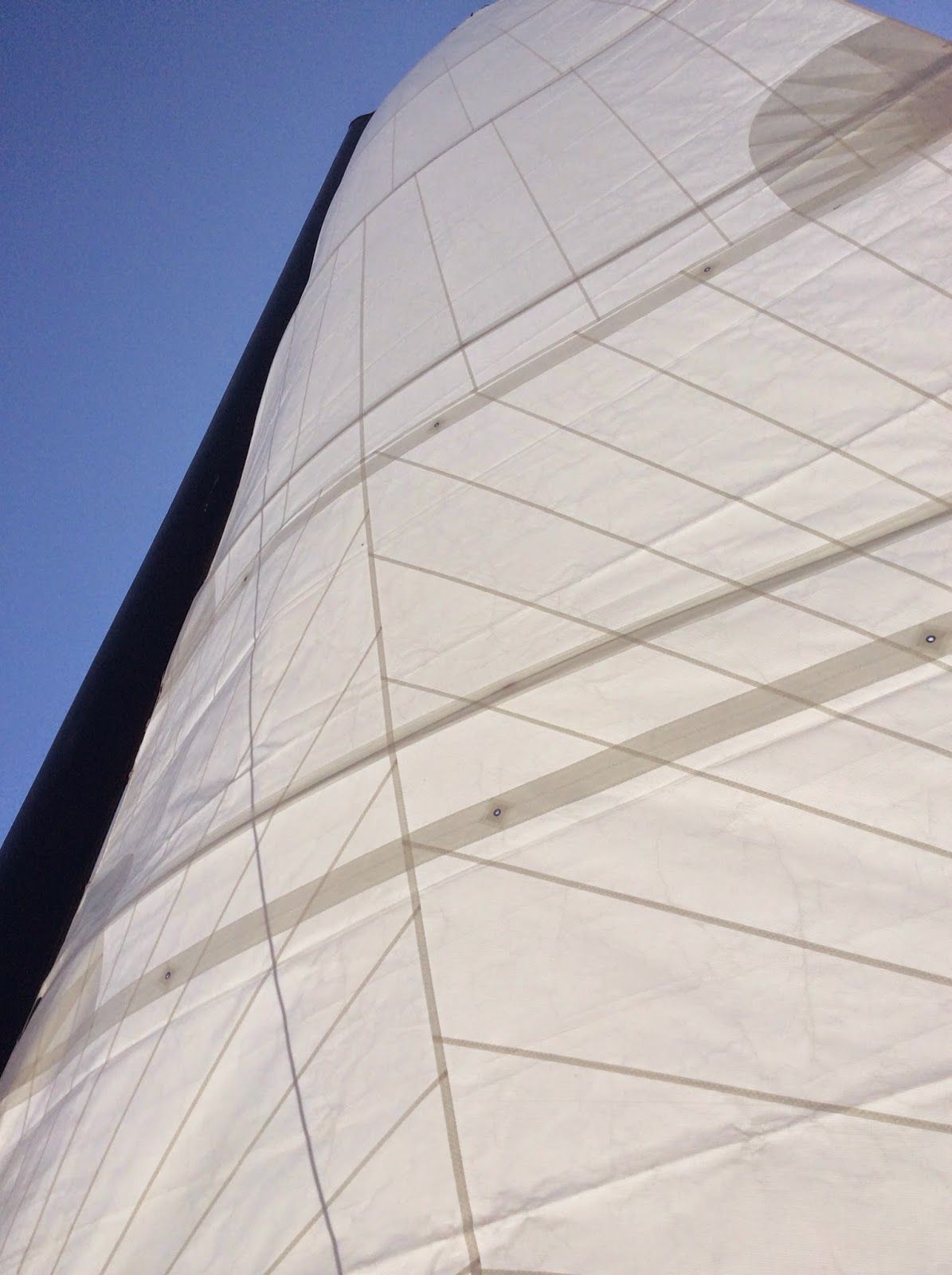
9.1 oz tri-radial tafetta

9.1 oz tri-radial tafetta. Pushed out the boom in about 3-4 knots of wind, just to see the shape, and get an idea of sail power.....
The sail went back to the loft for some minor alterations. One car instead of two between the battens, so they don't stack up too much when lowered. Thicker battens in the lower parts of the sails, and a 3rd (storm) reef. I had figured that a storm reef could be the wing masts without then sails but Ed eventually convinced me that we should put another reef in for more flexibility.

October 01, 2014

Zen Master Dogen

When you ride in a boat and watch the shore, you might assume that the shore is moving. But when you keep your eyes closely on the boat, you can see that the boat moves. Similarly, if you examine myriad things with a confused body and mind you might suppose that your mind and nature are permanent. When you practice intimately and return to where you are, it will be clear that nothing at all has unchanging self.

September 29, 2014

Raised a sail

The sails have been made (by Doyle Sails) so we raised one of them to check the fit. Good and like the shape. Deliberately raised it in light winds (by hand, AND singlehanded most of the way) as the halyard winch is not yet attached) and still surprised at how much power it seemed to have.

The sail is 61 m2 which makes 75 m2 if the wing mast is included. We like the shape :-) 

The story of the Mexican fisherman

An American investment banker was at the pier of a small coastal Mexican village when a small boat with just one fisherman docked. Inside the small boat were several large yellowfin tuna. The American complimented the Mexican on the quality of his fish and asked how long it took to catch them.The Mexican replied, “only a little while. The American then asked why didn’t he stay out longer and catch more fish? The Mexican said he had enough to support his family’s immediate needs. The American then asked, “but what do you do with the rest of your time?”The Mexican fisherman said, “I sleep late, fish a little, play with my children, take siestas with my wife, Maria, stroll into the village each evening where I sip wine, and play guitar with my amigos. I have a full and busy life.”The American scoffed, “I am a Harvard MBA and could help you. You should spend more time fishing and with the proceeds, buy a bigger boat. With the proceeds from the bigger boat, you could buy several boats, eventually you would have a fleet of fishing boats. Instead of selling your catch to a middleman you would sell directly to the processor, eventually opening your own cannery. You would control the product, processing, and distribution. You would need to leave this small coastal fishing village and move to Mexico City, then LA and eventually New York City, where you will run your expanding enterprise.”The Mexican fisherman asked, “But, how long will this all take?”
To which the American replied, “15 – 20 years.“But what then?” Asked the Mexican.
The American laughed and said, “That’s the best part. When the time is right you would announce an IPO and sell your company stock to the public and become very rich, you would make millions!”
“Millions – then what?”
The American said, “Then you would retire. Move to a small coastal fishing village where you would sleep late, fish a little, play with your kids, take siestas with your wife, stroll to the village in the evenings where you could sip wine and play your guitar with your amigos.”

May 30, 2014

Assymetrical rudder/daggerboards

The builder is the crazy Dutchman on the left, I think. Professionally built, as they will take the most stress.

Now need to attach them to the hull somehow. Even though I told him that there was nothing personal in it, Ray was most disappointed that his round round drums for flipping up the dagger boards had been removed. I had had a Eureka moment, after struggling to find way to allow the rudder/daggerboards to flip up if hit, while at the same time be easily set.


The boards were deliberately made extra long so they could be cut back if necessary.
It might be necessary.......

May 27, 2014

Square topped sail design

To be square topped, trisail taffeta. The reasons for square topped are to give greater sail area and to spill wind in gusts. We shall see.