September 29, 2014

The story of the Mexican fisherman

An American investment banker was at the pier of a small coastal Mexican village when a small boat with just one fisherman docked. Inside the small boat were several large yellowfin tuna. The American complimented the Mexican on the quality of his fish and asked how long it took to catch them.The Mexican replied, “only a little while. The American then asked why didn’t he stay out longer and catch more fish? The Mexican said he had enough to support his family’s immediate needs. The American then asked, “but what do you do with the rest of your time?”The Mexican fisherman said, “I sleep late, fish a little, play with my children, take siestas with my wife, Maria, stroll into the village each evening where I sip wine, and play guitar with my amigos. I have a full and busy life.”The American scoffed, “I am a Harvard MBA and could help you. You should spend more time fishing and with the proceeds, buy a bigger boat. With the proceeds from the bigger boat, you could buy several boats, eventually you would have a fleet of fishing boats. Instead of selling your catch to a middleman you would sell directly to the processor, eventually opening your own cannery. You would control the product, processing, and distribution. You would need to leave this small coastal fishing village and move to Mexico City, then LA and eventually New York City, where you will run your expanding enterprise.”The Mexican fisherman asked, “But, how long will this all take?”
To which the American replied, “15 – 20 years.“But what then?” Asked the Mexican.
The American laughed and said, “That’s the best part. When the time is right you would announce an IPO and sell your company stock to the public and become very rich, you would make millions!”
“Millions – then what?”
The American said, “Then you would retire. Move to a small coastal fishing village where you would sleep late, fish a little, play with your kids, take siestas with your wife, stroll to the village in the evenings where you could sip wine and play your guitar with your amigos.”

May 30, 2014

Assymetrical rudder/daggerboards

The builder is the crazy Dutchman on the left, I think. Professionally built, as they will take the most stress.

Now need to attach them to the hull somehow. Even though I told him that there was nothing personal in it, Ray was most disappointed that his round round drums for flipping up the dagger boards had been removed. I had had a Eureka moment, after struggling to find way to allow the rudder/daggerboards to flip up if hit, while at the same time be easily set.


The boards were deliberately made extra long so they could be cut back if necessary.
It might be necessary.......

May 27, 2014

Square topped sail design

To be square topped, trisail taffeta. The reasons for square topped are to give greater sail area and to spill wind in gusts. We shall see.


February 04, 2014

Color change

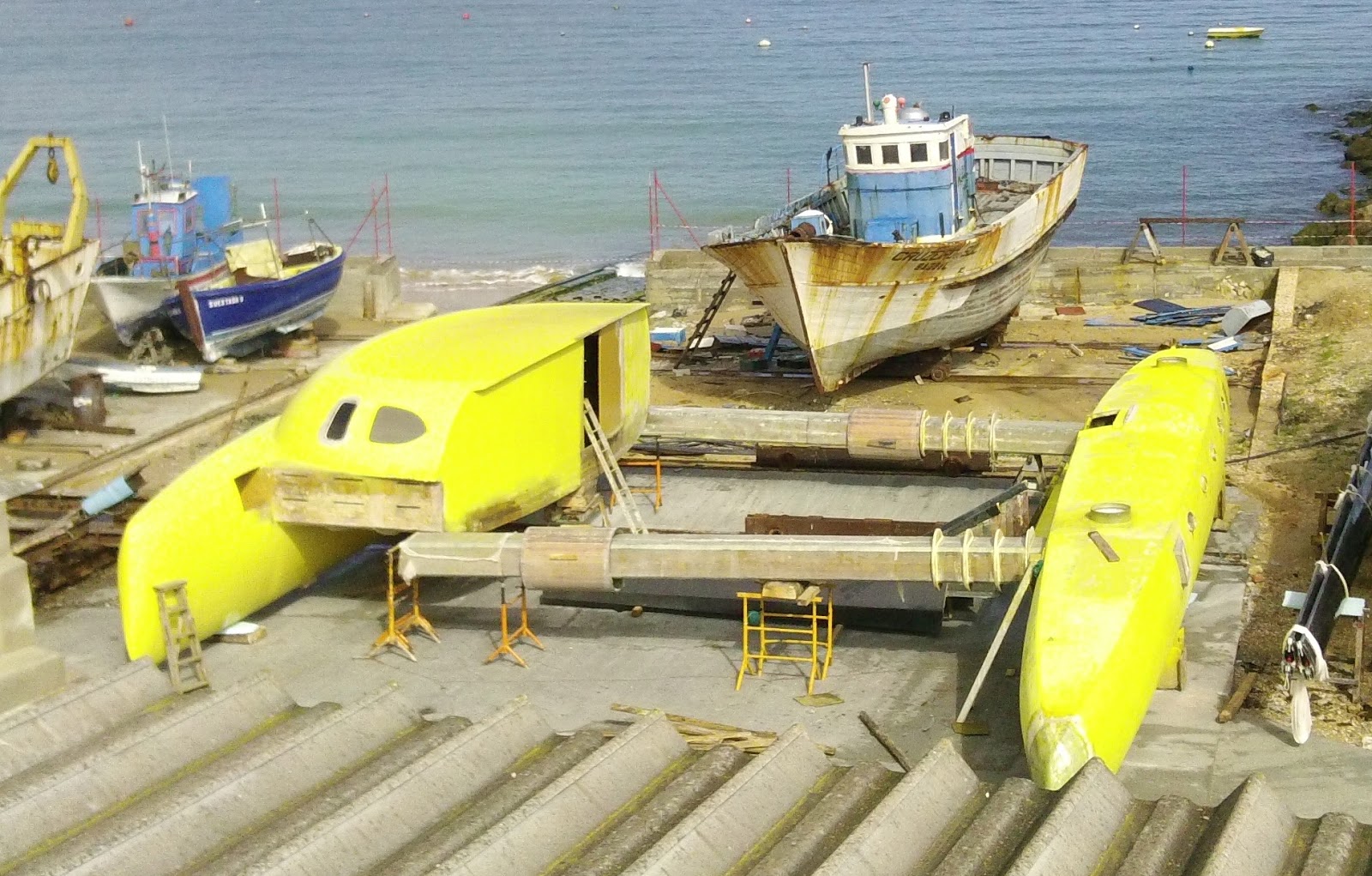
Colour change....due to fairing and sealing, which is taking a long time. 50knot gusts blew the mast tips about half a metre

August 17, 2013

Working at the boatyard

The old wooden fishing boat in previous pics has been dismantled. It was too expensive to run compared to modern metal hulls, because of massive weight of around 65 tons and necessity to caulk etc every few years.


OK we have to pay more rental and Sagres is 20 miles away, but the working atmosphere is so much better.
Made and installed a plywood beam from the ww hull entrance to the lee hull entrance. Then proceeded to make decking in between with small ply (Okoume) beams and Foam/glass between. Doing this to make it easier to install masts (still wrapped on the right), and attach the booms which can be seen beside the masts.


Took a while to get the far mast through the top bearing and slotted into the bottom bearing  as the top one was a tight fit and they are about 75 cm long. The nearer mast slotted in much easier and could easily be swung around by hand.


The gap in the decking is where a ramp will go. This cannot be made until I have an RIB and its hull shape to work from so it can slot in the ramp and be tied down. Once tied down with a 20 HP outboard still attached, we will see how well she can propel the boat, and from that decide what additional propulsion is required.


April 08, 2013

Come together

The beams weighed about 500 kilos each, but all the lifting was done by 4 manpower, jacks, comalongs rope and peel ply.
-Peel ply?
-Yes, it is surprisingly strong and stretched less than the rope

Although a tight fit it was easy enough to slide the beams into the lee hull.


Th difficult part was slipping the beams into the slots of the windward hull. Doing it the other way round was not an option due to the amount of reinforcing around the lee hull beam slot and UHMWPE mast bearings which were already installed.


We got the further beam slotting in easily enough, but know amount of pulling with cum-alongs and altering the 'horizontality' of the hulls would get the closer beam to go all the way. Eventually we had to cut out the bit of the ww hull above the beam slot, shave things a bit, and slide then slide the beams in all the way.
This gave us the opportunity to really glue the near beam to the hull.  Pic was taken before reinstalling the hull piece over the beam

February 15, 2013

The move


At last, all the permits for moving two 'Excepcional' loads.


About 3 hours two move in 5 stages to the flatbed at the roadside craning over trees, wires and a field. Did I mention we managed to snag an electric cable and almost deprived a villa of electricity?


The lee hull stuck out 7 metres from the back of the not 'Excepcional' enough lowed truck, along with the two wing masts, and these  proceeded first at speeds up to 60 km/hr with me driving behind nervously. Then an hour to unload at the boatyard, so too late for a second load the same day.


Same procedure the second day but slightly more difficult to get the windward hull/ pod to the roadside, and also to tie securely to the flatbed. I asked the driver to go a bit slower this time partly because the width meant it took up a bit of the other side of the road, but mainly because I would be driving nervously behind.....

January 27, 2013

2012 Update


Lee Hull painted a bit


WW hull shell semi complete, working on wing masts


Wing masts coated with twee carbon fibre twill just for looks (Ed's idea). We are ready to put the pieces together, so maybe move to somewhere closer to the water in the New Year, as she will become too wide to take to the roads once put together.


February 19, 2011

The discovery of Luca Antara

Supposedly, the Dutch, ‘first discovered’ Australia in 1606. However, there may have been an earlier Portuguese exploration of the Tiwi Islands (Melville and Bathurst) in northern Australia around 1600. A 1602 map, by Emanuel Godinho de Eredia, then a leading cartographer, probably depicts these islands, then known as 'Luca Antara'.


Erédia, Manuel Godinho de (1563 - 1623)

ERÉDIA, MANUEL GODINHO DE (1563-1623), Malay-Portuguese author, was born in Malacca, on the Malayan Peninsula, on his father's side of Aragonese descent, while his mother was a Macassarese of good family, according to his own account a princess. He was educated at Malacca and at the Jesuit seminary at Goa, and soon after leaving there in 1580 conceived the design of finding the Isles of Gold which figured prominently in Malayan legend. In Erédia's conception they lay approximately in the position of north-west Australia. It is just possible that Australia may have been sighted in 1521 by Cristovão da Mendonça, who led one of several Portuguese expeditions in search of the islands about that time, for it is difficult to explain the remarkable series of 'Dieppe maps' without assuming some Portuguese knowledge of the continent. Erédia, however, based himself essentially on Ptolemy, Polo, and Ludovico di Varthema, and on reports of contemporary Malay voyages, accidental and deliberate, to the south-east of Timor. Armed with this documentation, he secured in 1594 a commission from Philip I of Portugal as Descobridor e Adelantado da Nova India Meridional; this title later misled Henry Major into acclaiming him as the actual first discoverer of Australia, though Erédia clearly shows that it was a rank and he never made the claim himself. By 1602 the viceroy, Aires de Saldanha, had appointed ships and men for the project, but local wars intervened and Erédia was called upon to play his part as a soldier and military engineer. The Portuguese dominion in the East sank into decrepitude, and in his last years Erédia was reduced to endless memorializing to unsympathetic officials.
The main source for Erédia's life and views is his own Declaracam de Malaca e da India Meridional com Cathay existing in his own manuscript at Brussels and published there by L. Janssens in 1882. Erédia was a good surveyor and cartographer and an excellent observer, and his work retains its importance as one of the best early accounts of the Malay peninsula, as well as its significance in the proto-history of Australian discovery. Although nothing came of his project, it seems probable that, buried in much fantasy, there is a core of genuine evidence as to Malay knowledge of Australia, or at least of Australian waters.

It seemed easier to do it this way


Only 5 months since the last post, getting better at this...The rainy winterish season slowed down the work a bit. We had hoped to work inside on the wing masts but the designer was dilatory so we made the drum part of the kick up rudder system.

When the weather got better we turned the upside down ww hull on it's side to do the cabin pod floor. It seemed the easiest way to keep the floor flat and also be able to glass the underside without having to do it from underneath.


Then we completed turning it the right way up nervously and carefully.


And started to shape the cabin sides.