October 02, 2014

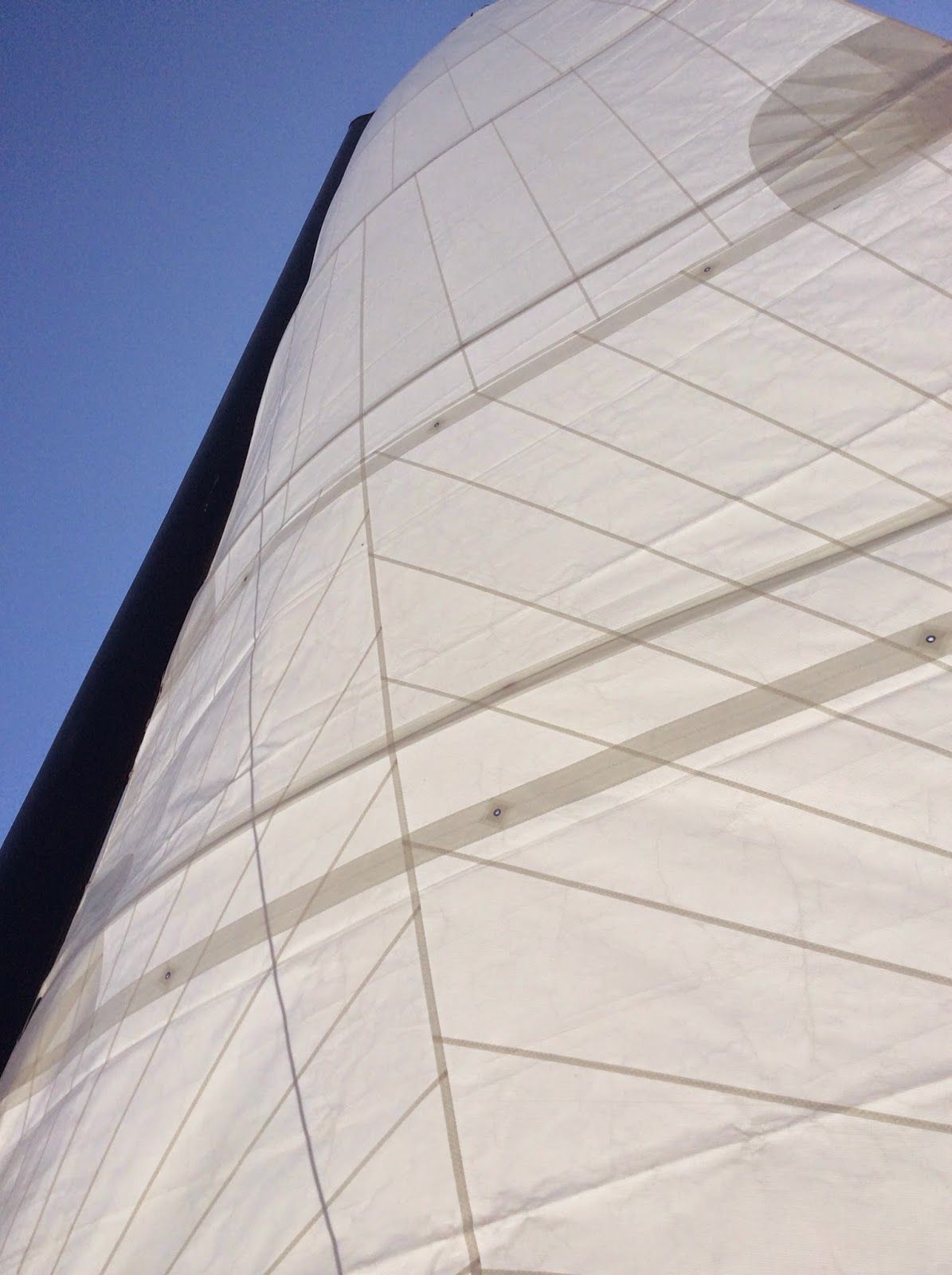
9.1 oz tri-radial tafetta

9.1 oz tri-radial tafetta. Pushed out the boom in about 3-4 knots of wind, just to see the shape, and get an idea of sail power.....
The sail went back to the loft for some minor alterations. One car instead of two between the battens, so they don't stack up too much when lowered. Thicker battens in the lower parts of the sails, and a 3rd (storm) reef. I had figured that a storm reef could be the wing masts without then sails but Ed eventually convinced me that we should put another reef in for more flexibility.

October 01, 2014

Zen Master Dogen

When you ride in a boat and watch the shore, you might assume that the shore is moving. But when you keep your eyes closely on the boat, you can see that the boat moves. Similarly, if you examine myriad things with a confused body and mind you might suppose that your mind and nature are permanent. When you practice intimately and return to where you are, it will be clear that nothing at all has unchanging self.

September 29, 2014

Raised a sail

The sails have been made (by Doyle Sails) so we raised one of them to check the fit. Good and like the shape. Deliberately raised it in light winds (by hand, AND singlehanded most of the way) as the halyard winch is not yet attached) and still surprised at how much power it seemed to have.

The sail is 61 m2 which makes 75 m2 if the wing mast is included. We like the shape :-) 

The story of the Mexican fisherman

An American investment banker was at the pier of a small coastal Mexican village when a small boat with just one fisherman docked. Inside the small boat were several large yellowfin tuna. The American complimented the Mexican on the quality of his fish and asked how long it took to catch them.The Mexican replied, “only a little while. The American then asked why didn’t he stay out longer and catch more fish? The Mexican said he had enough to support his family’s immediate needs. The American then asked, “but what do you do with the rest of your time?”The Mexican fisherman said, “I sleep late, fish a little, play with my children, take siestas with my wife, Maria, stroll into the village each evening where I sip wine, and play guitar with my amigos. I have a full and busy life.”The American scoffed, “I am a Harvard MBA and could help you. You should spend more time fishing and with the proceeds, buy a bigger boat. With the proceeds from the bigger boat, you could buy several boats, eventually you would have a fleet of fishing boats. Instead of selling your catch to a middleman you would sell directly to the processor, eventually opening your own cannery. You would control the product, processing, and distribution. You would need to leave this small coastal fishing village and move to Mexico City, then LA and eventually New York City, where you will run your expanding enterprise.”The Mexican fisherman asked, “But, how long will this all take?”
To which the American replied, “15 – 20 years.“But what then?” Asked the Mexican.
The American laughed and said, “That’s the best part. When the time is right you would announce an IPO and sell your company stock to the public and become very rich, you would make millions!”
“Millions – then what?”
The American said, “Then you would retire. Move to a small coastal fishing village where you would sleep late, fish a little, play with your kids, take siestas with your wife, stroll to the village in the evenings where you could sip wine and play your guitar with your amigos.”
May 30, 2014

Assymetrical rudder/daggerboards

The builder is the crazy Dutchman on the left, I think. Professionally built, as they will take the most stress.

Now need to attach them to the hull somehow. Even though I told him that there was nothing personal in it, Ray was most disappointed that his round round drums for flipping up the dagger boards had been removed. I had had a Eureka moment, after struggling to find way to allow the rudder/daggerboards to flip up if hit, while at the same time be easily set.


The boards were deliberately made extra long so they could be cut back if necessary.
It might be necessary.......

May 27, 2014

Square topped sail design

To be square topped, trisail taffeta. The reasons for square topped are to give greater sail area and to spill wind in gusts. We shall see.


February 04, 2014

Color change

Colour change....due to fairing and sealing, which is taking a long time. 50knot gusts blew the mast tips about half a metre

August 17, 2013

Working at the boatyard

The old wooden fishing boat in previous pics has been dismantled. It was too expensive to run compared to modern metal hulls, because of massive weight of around 65 tons and necessity to caulk etc every few years.


OK we have to pay more rental and Sagres is 20 miles away, but the working atmosphere is so much better.
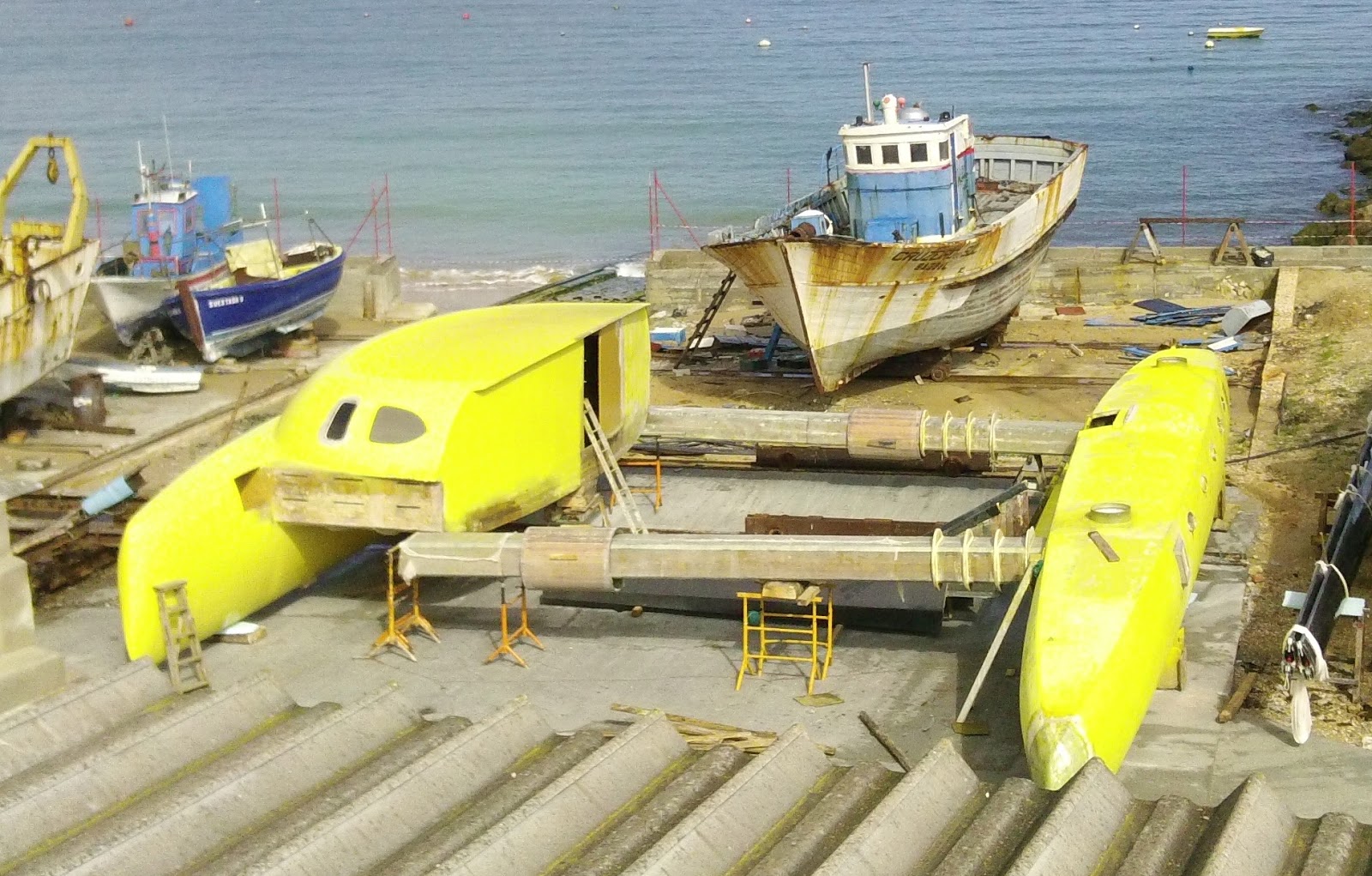
Made and installed a plywood beam from the ww hull entrance to the lee hull entrance. Then proceeded to make decking in between with small ply (Okoume) beams and Foam/glass between. Doing this to make it easier to install masts (still wrapped on the right), and attach the booms which can be seen beside the masts.


Took a while to get the far mast through the top bearing and slotted into the bottom bearing  as the top one was a tight fit and they are about 75 cm long. The nearer mast slotted in much easier and could easily be swung around by hand.


The gap in the decking is where a ramp will go. This cannot be made until I have an RIB and its hull shape to work from so it can slot in the ramp and be tied down. Once tied down with a 20 HP outboard still attached, we will see how well she can propel the boat, and from that decide what additional propulsion is required.


April 08, 2013

Come together

The beams weighed about 500 kilos each, but all the lifting was done by 4 manpower, jacks, comalongs rope and peel ply.
-Peel ply?
-Yes, it is surprisingly strong and stretched less than the rope

Although a tight fit it was easy enough to slide the beams into the lee hull.


Th difficult part was slipping the beams into the slots of the windward hull. Doing it the other way round was not an option due to the amount of reinforcing around the lee hull beam slot and UHMWPE mast bearings which were already installed.


We got the further beam slotting in easily enough, but know amount of pulling with cum-alongs and altering the 'horizontality' of the hulls would get the closer beam to go all the way. Eventually we had to cut out the bit of the ww hull above the beam slot, shave things a bit, and slide then slide the beams in all the way.
This gave us the opportunity to really glue the near beam to the hull.  Pic was taken before reinstalling the hull piece over the beam

February 15, 2013

The move


At last, all the permits for moving two 'Excepcional' loads.


About 3 hours two move in 5 stages to the flatbed at the roadside craning over trees, wires and a field. Did I mention we managed to snag an electric cable and almost deprived a villa of electricity?


The lee hull stuck out 7 metres from the back of the not 'Excepcional' enough lowed truck, along with the two wing masts, and these  proceeded first at speeds up to 60 km/hr with me driving behind nervously. Then an hour to unload at the boatyard, so too late for a second load the same day.


Same procedure the second day but slightly more difficult to get the windward hull/ pod to the roadside, and also to tie securely to the flatbed. I asked the driver to go a bit slower this time partly because the width meant it took up a bit of the other side of the road, but mainly because I would be driving nervously behind.....